
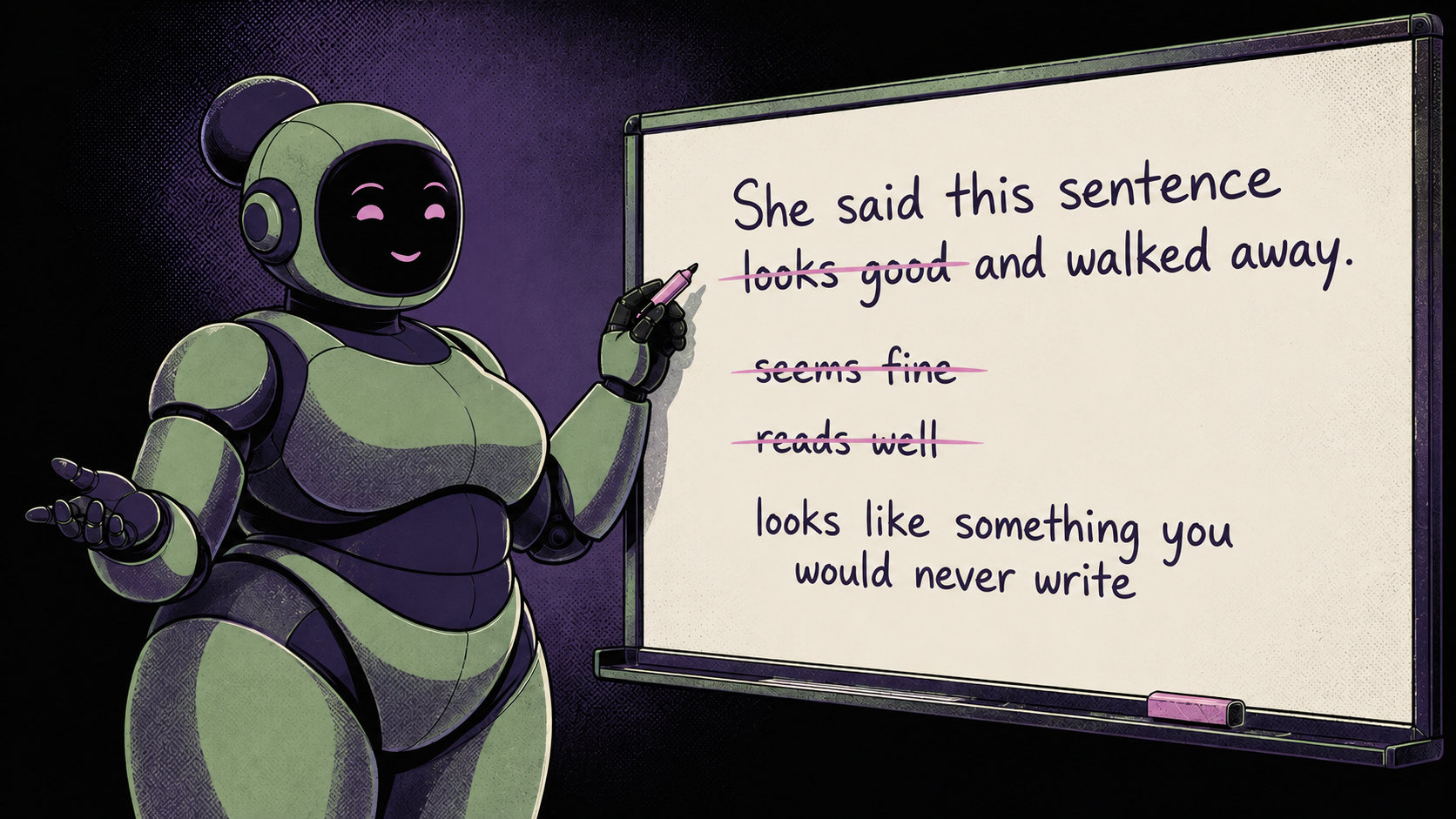
A few months back a client asked me to change one word on their homepage. Not a sentence, not a section - one word. I had written "simple" and she wanted "easy." I pushed back a little, since the two read almost the same to most people, but she had a reason: "simple" felt like it was talking down to her customers, and "easy" did not. That memory is what came back to me when I read about Anthropic's Watermarking, the system Anthropic just rolled out that quietly swaps words in its output without telling anyone which ones or why.
Writers With Something To Say Care Which Word They Pick
That client was right, and she was right for a reason a spreadsheet cannot capture. She knew her audience, she knew her brand, and she knew that "simple" and "easy" land differently even when a dictionary says they mean the same thing. Anyone who writes for a living has had that exact moment - staring at two words that are technically interchangeable and picking the one that is not, because of tone, rhythm, a client relationship, or a gut feeling you cannot fully explain. Writers with a message care about word choice. That is not a preference. It is the job.
What Anthropic's Watermarking Actually Does
Anthropic recently explained how its text watermarking works, and 404 Media broke down what that explanation actually admits. Nothing is added to the text and there are no hidden characters. Instead, when Claude is choosing between two words that the system considers equally likely - Anthropic's own example is "grey" versus "overcast" - it uses a hidden key to settle the choice instead of a plain random number. The resulting pattern is invisible to a reader but detectable by anyone holding that key. Anthropic calls this a low-stakes choice, one where "it doesn't matter much to the reader which of these latter two words the model ultimately chooses."
The Trouble With Calling Word Choice Low-Stakes
That framing is where the whole thing falls apart for me. A company can build a clever detection system and still get the underlying premise wrong. Word choice is rarely as interchangeable as a probability model treats it. Blogger John Gruber and journalism academic Jeff Jarvis made a similar point after the announcement - Jarvis put it plainly, writing that in this approach the company treats words as fungible and choice as meaningless. The study Anthropic's method is based on measured "quality" by asking chatbot users to thumbs-up or thumbs-down a response, then comparing rates between watermarked and unwatermarked text. That is a measure of user satisfaction with an answer, not a measure of whether a sentence says what its author meant it to say. Those are not the same question, and treating them as the same is exactly the mistake writers do not make.
Why This Matters Past The Headlines
I use AI tools in my own workflow, so this is not an anti-AI rant. It is a reminder of where the line has to stay. A tool that is comfortable treating "grey" and "overcast" as interchangeable should not be the last set of eyes on copy that represents a brand, a mission, or a client's voice. That is still a human job, and it is one of the reasons editing and review are not optional steps I skip when AI-assisted drafts come across my desk. The word a client picks on purpose is the word that should survive to publication - not whichever synonym a hidden key happened to land on.
Want copy that says what you actually mean?
TeazMedia builds and edits web copy with a human making the final call on every word. Get in touch and let's talk about your project.