
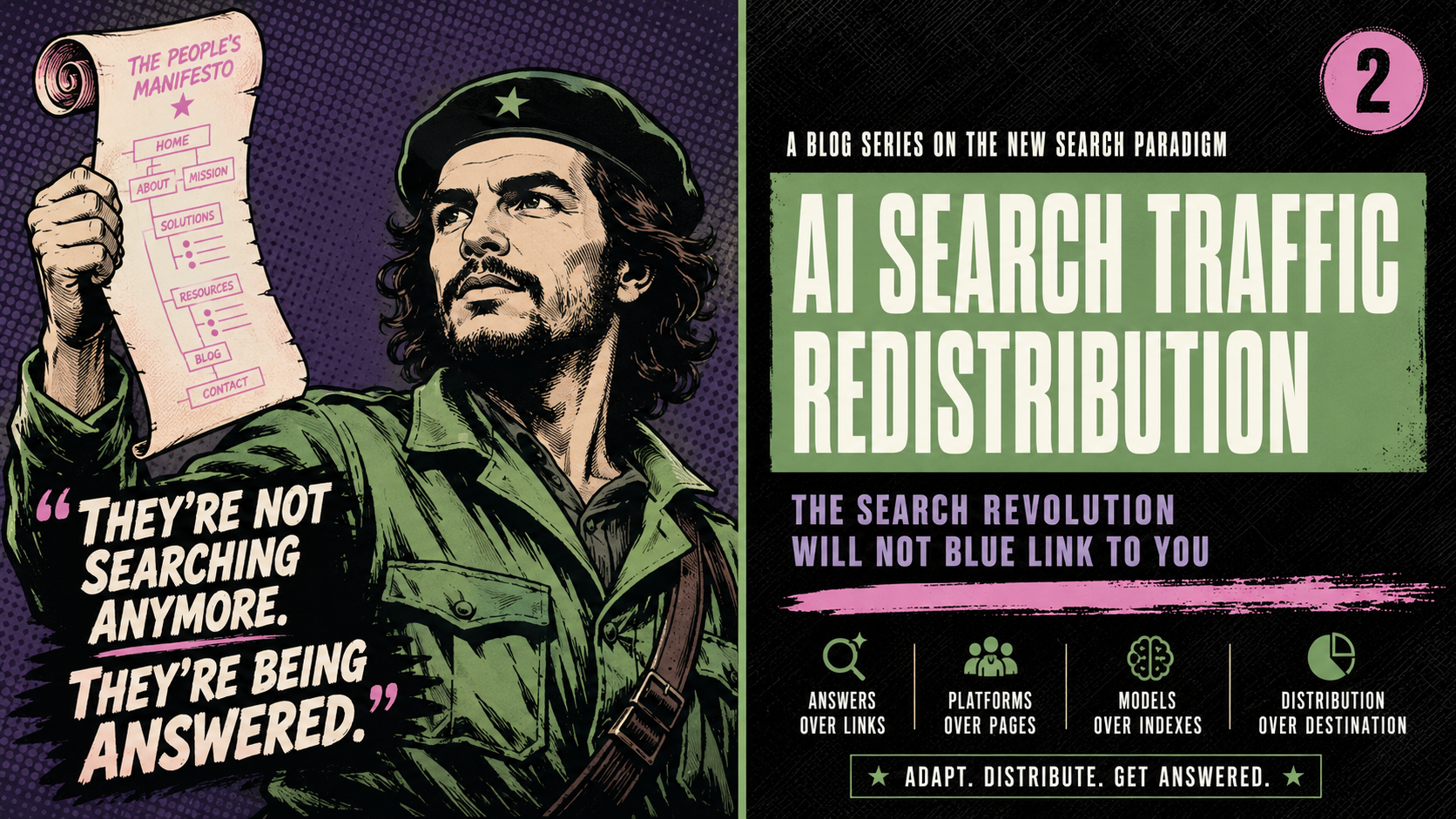
AI search traffic redistribution is already showing up in your analytics -- impressions holding steady, clicks quietly retreating. No announcement. No farewell tour. Google did not hold a press conference to explain that the blue link was being reassigned. It just started building a better answer -- one that lives entirely inside the search results page, requires no click to access, and has absolutely no reason to send anyone to your website.
Welcome to AI search. Population: everyone except your traffic.
The Box That Ate the Internet
At Google I/O in May 2026, the company announced what it called the biggest upgrade to the Google Search box in over 25 years. A new intelligent search interface powered by Gemini 3.5 Flash -- Google's latest frontier model -- that accepts text, images, files, video, and Chrome tabs as inputs. It anticipates your intent before you finish typing. It holds a conversation. It builds interactive tools on the fly.
And it runs 24 hours a day, 7 days a week, on Google's servers. Not on your phone. Not limited by a battery or a sleep state. Google's infrastructure, continuously reading the web, synthesizing answers, and delivering them before a human being has decided whether they even want to click anything.
The search box used to be a door. You walked through it to get somewhere. Now it is trying very hard to be the destination itself.
Agents in the Background, Quietly Doing Your Job
The part of the I/O announcement that got less attention than the shiny new search box is the part worth paying attention to. Google introduced Information Agents -- persistent background processes that monitor the web continuously on a user's behalf, synthesize what they find, and deliver updates without being asked.
Think of it as Google Alerts, but one that actually works, reasons across sources, and writes you a coherent briefing instead of dumping raw links into your inbox.
For a nonprofit that publishes regular program updates, impact reports, or advocacy content, this is worth sitting with for a moment. Your audience used to search for information, land on your site, read something, maybe donate, maybe share. That chain of events assumed a click somewhere in the middle. Agents do not click. They read, synthesize, and report back. Your content becomes an input, not a destination.
This is not a catastrophe. It is a shift. Those two things require very different responses.
Zero Click Was Already Happening
To be fair -- and fairness is a revolutionary virtue -- zero click search is not new. Featured snippets, knowledge panels, and AI Overviews have been quietly intercepting traffic for years. What changed at I/O 2026 is the scale, the sophistication, and the permanence of the intent.
Google is not experimenting with keeping users on Google anymore. It has committed. Gemini 3.5 Flash is the default model for everyone globally. AI Mode has surpassed one billion monthly users. The company spent somewhere between $180 and $190 billion on AI infrastructure this year. This is not a feature. It is the product.
The question is not whether AI search changes how people find your organization. It already has. The question is whether your content is good enough to be the source that gets synthesized -- or whether it gets skipped entirely in favor of someone who thought harder about structure, clarity, and authority signals.
The Revolutionary Act Is Not Panic
Here is where the manifesto earns its keep. The wrong response to all of this is to chase the algorithm. Build more pages. Stuff more keywords. Pray to the structured data gods and hope for a featured snippet. That approach was already tired before agents existed.
The right response is to make your content genuinely worth citing. AI systems -- whether Google's agents, or the large language models your audience uses to ask questions directly -- pull from sources that demonstrate clear expertise, consistent structure, and honest specificity. Vague mission statements and committee-approved copy do not make the cut. Concrete, well-organized, human-written content about real work does.
This means your website still matters. It just matters differently. It is no longer primarily a traffic destination. It is increasingly a credibility signal and a source document -- the thing an AI cites when it tells someone about your organization, your cause, or your area of expertise.
Getting that right requires a different kind of thinking than SEO as it was practiced five years ago. It requires understanding how AI systems discover, evaluate, and reference content. Which is, not coincidentally, exactly what Generative Engine Optimization is for.
The Links Are Not Gone. They Are Just Further Back.
Someone will still click through to your site. But the volume, the behavior, and the intent of that traffic is changing fast. The audience that finds you via a direct click in 2026 is more deliberate, more informed, and further along in their decision-making than the casual browser of five years ago. That is actually good news if your content is ready for them.
The search revolution will not blue link to you. But it will read you, summarize you, and decide whether you are worth mentioning. That is a different kind of discoverability -- and it is the one worth building for right now.
If you want to understand what that looks like in practice for a mission-driven organization, start with this breakdown of GEO for nonprofits. The infrastructure decisions that make your site legible to AI systems are not complicated -- but they do need to be intentional.
The revolution, as it turns out, is mostly about being findable in the right way at the right time. Slightly less dramatic than a beret would suggest. Significantly more important than most people realize.