
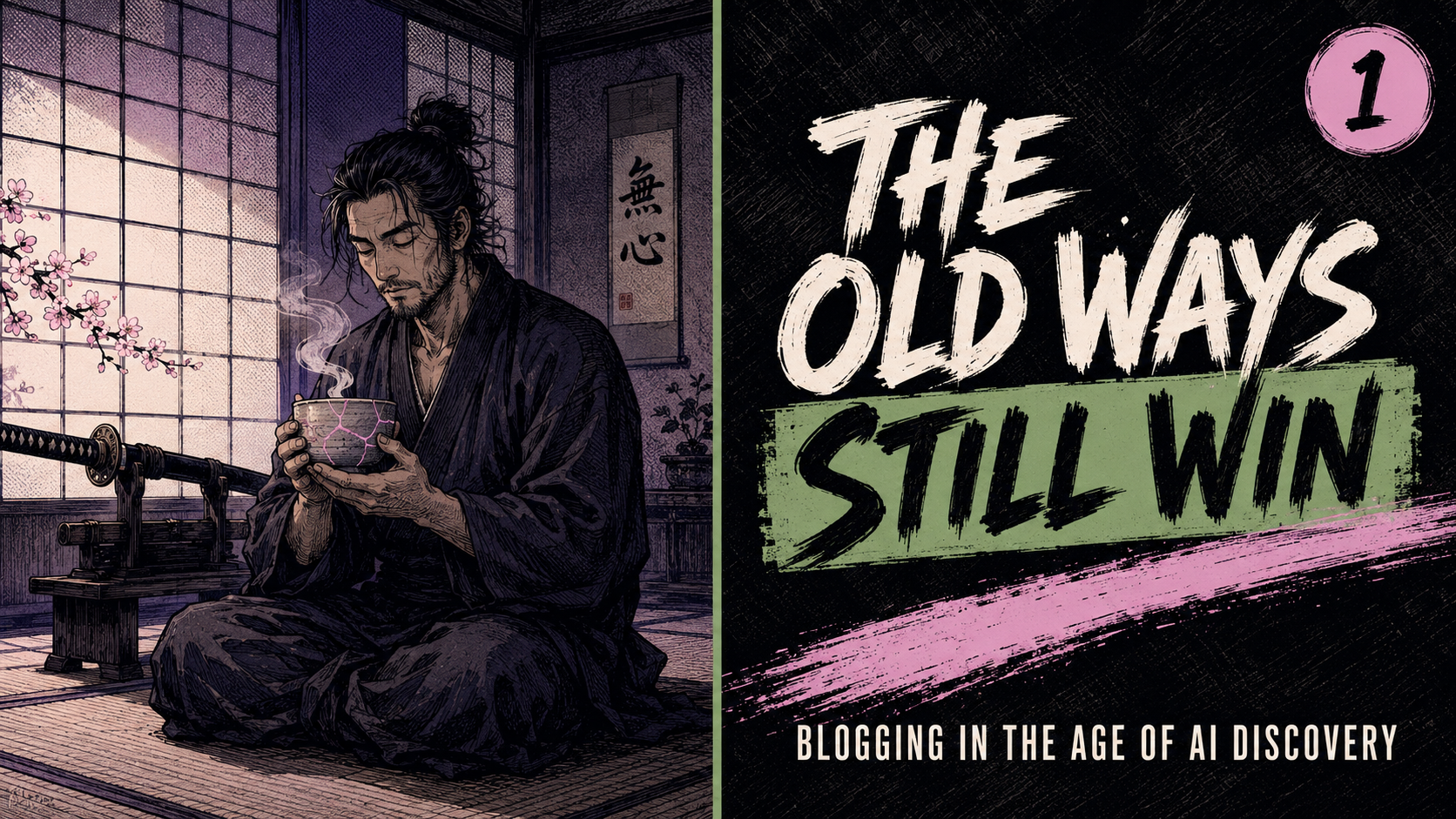
Blogging is not dead. In 2026, it is one of the most powerful tools available for AI-driven content discovery. Organizations that publish structured, authoritative long-form content are being cited directly by ChatGPT, Google AI Overviews, and Gemini -- reaching audiences who never click a traditional search result.
There is a Japanese proverb that says: "Even if you stumble, do not forget what you were aiming for." Digital marketing stumbled hard on blogging. Blogging for AI discovery is now the strategic reset that most organizations have not made yet.
Being found means that blogging for AI discovery is more important now than ever.
Blogs Did Not Die. The Strategy Around Them Did.
Around 2019, the conventional wisdom shifted fast. Engagement metrics on social platforms were climbing. Organic search traffic felt unpredictable. Agencies started telling clients to move toward Instagram, TikTok, and LinkedIn carousels -- anything that generated visible, immediate results.
Blog publishing slowed across nearly every sector. The posts that did get published became shorter, thinner, and more keyword-stuffed. Google's algorithm updates punished exactly that kind of content, which reinforced the narrative that blogging was broken.
The format was never the problem. The execution was.
A well-structured blog post built around genuine expertise, real data, and clear answers to specific questions never stopped performing. It just became harder to see its value when the entire industry was chasing short-term engagement instead of long-term authority.
That distinction matters enormously now.
What Changed: AI Discovery Rewrote the Rules
In 2025, something fundamental shifted in how people find information. AI-powered search tools became primary discovery channels for a significant and growing portion of the population.
- By October 2025, McKinsey reported that 50% of consumers were using AI-powered search as their primary method for finding information and making buying decisions. (McKinsey, 2025)
- Web sessions referred by AI sources jumped 527% year-over-year in the first five months of 2025. (Previsible AI Traffic Report, 2025)
- ChatGPT reached 800 million weekly active users by October 2025, doubling from 400 million in February of that year. (OpenAI, 2025)
Those AI systems do not pull from social media carousels. They do not cite Instagram posts. They pull from structured, substantive, authoritative written content -- exactly what a well-executed blog post provides.
The organizations publishing consistent, high-quality blog content throughout the years when everyone said blogs were dead are now sitting on a significant competitive advantage. Their archives are being read -- not always by humans clicking through from Google, but by AI systems synthesizing answers and looking for credible sources to cite.
How AI Engines Decide What to Cite
Understanding this requires a clear look at what generative AI actually values in content. When ChatGPT or Google AI Overview constructs an answer, it looks for content that is easy to extract and trust.
Direct answers first. Content that answers the core question within the first 40 to 60 words performs significantly better in AI citation than content that buries the lead.
Factual density. Posts that include specific statistics, named sources, and concrete data points roughly every 150 to 200 words give AI systems more extractable material. Vague claims get passed over. Precise ones get pulled.
Clear structure. Logical headers, organized flow, and content built around real questions signal reliability to AI systems. Schema markup amplifies this further -- Princeton University research found that properly structured content shows 30 to 40% higher AI visibility compared to unoptimized content. (Princeton GEO Study, 2024)
Content freshness. A post last updated in 2022 loses ground to one updated in 2026 on the same topic. Visible last-updated dates and current statistics are now active signals for AI citation -- not optional polish.
None of these principles require a large budget. They require consistency and discipline -- which is exactly what the best bloggers always practiced, long before AI search existed.
What a Cold Tuesday Taught Me About Content
Last year, a client -- a small environmental nonprofit -- came to me ready to shut their blog down entirely. They had been publishing one to two posts a month for nearly three years. Traffic was modest. The effort felt invisible. They wanted to redirect everything toward social media.
I asked them to hold off for 90 days.
We did not write a single new post that quarter. Instead, we restructured what already existed -- tightened the openings, added sourced data, cleaned up the headers, added schema markup.
By the end of those 90 days, three of their posts were surfacing in AI Overview results for search terms directly tied to their mission. Donor inquiries referencing "I found you through ChatGPT" started appearing in their contact form. Not dozens -- but enough to make the point clearly.
The content had been doing quiet work the entire time. It just needed the right structure to be recognized.
Blogging for AI Discovery: How to Structure Content in 2026
If you have an existing blog, you are closer to a GEO advantage than you probably realize. The archive you have built -- even if it feels outdated -- is raw material that AI systems can cite once it is properly structured.
Lead with the answer. Every post should open with a direct response to the question it addresses within the first two sentences. Answer first. Support second.
Build in data. Each post should include at minimum two or three specific statistics with named sources. This signals credibility to both readers and AI systems.
Update your best posts quarterly. Add a visible last-updated date. Swap in current statistics. Add a brief note on what has changed since the original publish date. This alone can meaningfully improve AI citation rates for evergreen content.
Add schema markup. On WordPress, Rank Math makes this straightforward. Article schema, FAQ schema, and Organization schema are the highest-priority implementations for AI visibility.
Publish on a schedule you can sustain. Consistency outperforms volume every time. One well-structured post per week outperforms three thin posts rushed out under pressure.
Frequently Asked Questions
Is blogging still relevant in 2026?
Yes. Blogging is more strategically important in 2026 than it has been in years. AI-powered search systems cite long-form structured content directly in their answers, making blogging for AI discovery one of the highest-leverage content strategies available today.
What is the difference between SEO and GEO for blogs?
Traditional SEO optimizes content to rank in a list of search results. GEO -- Generative Engine Optimization -- optimizes content to be cited inside AI-generated answers. Both matter in 2026, and blog content structured for GEO typically performs well for traditional SEO simultaneously.
How long should a blog post be for AI citation?
There is no fixed minimum, but posts between 1,000 and 2,000 words that include clear headers, sourced statistics, and direct answers to specific questions consistently outperform shorter or less structured content in AI citation analysis.
How often should I update existing blog posts?
A quarterly refresh cycle is the current best practice. Update statistics, add a visible last-updated date, and note any changes in the field since the original publish date.
Where can I learn more about AI discovery and GEO research?
Several authoritative sources are worth bookmarking. Princeton University's foundational GEO research outlines how generative engines select and cite content. McKinsey's 2025 AI marketing report documents how consumer search behavior has shifted toward AI-powered tools. Google's helpful content guidelines remain the baseline standard for content quality that both search engines and AI systems reward.
Ready to Make Your Content Work Harder?
If your blog has been sitting on the sidelines, it may be closer to an AI citation advantage than you think. We help organizations structure, update, and optimize their content for blogging for AI discovery -- without starting from scratch.
The Competitive Reality
As of early 2026, 47% of brands have no GEO strategy in place. (Dataslayer GEO Report, 2026) That gap is an opportunity -- but it is closing. Enterprise marketing teams began standing up dedicated AI visibility roles in late 2025. Agencies are restructuring service offerings around GEO retainers.
The window where blogging for. AI discovery gives smaller organizations a meaningful edge over larger competitors is real. It is also not permanent.
The old ways -- publishing consistently, writing with authority, citing real sources, organizing content clearly -- did not stop working. The tools that evaluate them just became significantly more sophisticated.
The organizations that understand this now will have a compounding content advantage by the time the rest of the market catches up.
Start there.