
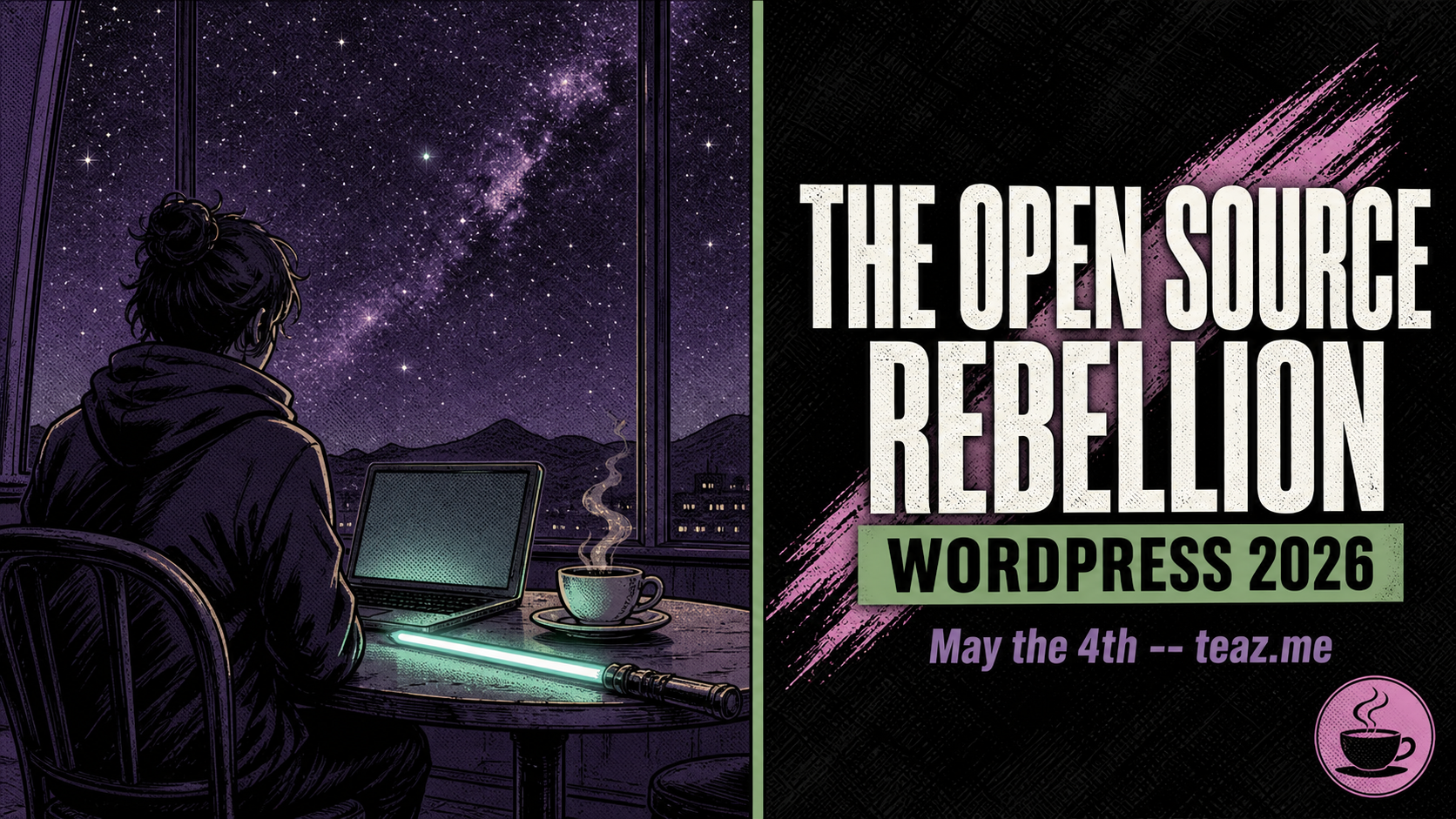
WordPress 2026 On This Day
May the 4th. You know the day.
Even if you're not the type to queue up a space opera marathon, there's something fitting about celebrating a story where a scrappy, decentralized rebellion holds its own against a monolithic empire built on control and lock-in.
That dynamic maps pretty cleanly onto the web platform landscape in 2026.
Last year I wrote a breakdown of WordPress and WooCommerce versus the big closed platforms -- Squarespace, Wix, and Shopify. A lot has happened since. WordPress 7.0 is dropping this month, the market share numbers have shifted, and the conversation around AI in your CMS has moved from "interesting experiment" to "core infrastructure."
Time to update the record.
Where WordPress Actually Stands in 2026
Here's a number worth sitting with: WordPress powers roughly 43% of all websites on the internet right now. Not CMS market share -- the entire web. Among sites that use a CMS at all, WordPress holds nearly 60% of the market.
Its closest competitor, Shopify, sits at around 5%. That's not a close race.
I'll be honest -- when I first got into WordPress, I assumed the platform would eventually get displaced by something shinier. Every year someone declares it's finally losing ground. Every year the W3Techs data tells a different story.
It keeps growing. Slowly, but consistently.
What's shifting underneath the headline number is more interesting. WordPress is gaining users in emerging markets, with non-English installations now outnumbering English ones. At the same time, developer-led greenfield projects are increasingly eyeing React-based frameworks and headless CMS options.
So you get a split: the install base keeps expanding while a segment of the developer community builds around WordPress rather than on it. That tension is real -- and it doesn't invalidate the platform. But it does mean WordPress has to keep earning its position.
WordPress 7.0: The Release That Actually Matters
WordPress 7.0 is scheduled to ship May 20, 2026 -- about two weeks out. It was originally targeted for April 9 during WordCamp Asia, but the core team delayed it to get the real-time collaboration architecture right.
That was the right call. Shipping something foundational before it's stable would have been worse than the wait.
Two things in 7.0 stand out as genuinely significant.
Built-in AI Infrastructure
WordPress 7.0 introduces a standardized AI layer directly into core -- the WP AI Client, the Connectors API, and the Abilities API. Instead of every plugin rolling its own connection to OpenAI, Anthropic, or Google, there's now a single abstraction layer.
You configure your preferred AI provider once under Settings > Connectors. Every plugin or theme that taps into the AI Client routes through that same setup. Provider switching becomes a configuration change, not a code rewrite.
This is the right architectural decision. The fragmented approach -- where each plugin managed its own credentials, its own prompt logic, its own provider lock-in -- was always going to cause problems at scale. Centralizing it in core cleans that up before it gets worse.
The three default providers are OpenAI, Google, and Anthropic. Community-built connectors for OpenRouter, Ollama, and Mistral are already in the plugin directory.
Real-Time Collaboration
Multiple users can now co-edit the same post or page simultaneously. Offline edits sync on reconnect. Notes and inline comments get real-time syncing as well.
This is Phase 3 of the Gutenberg project -- the shift from WordPress as a solo publishing tool to WordPress as a team content platform. For anyone who's ever copy-pasted a Google Doc draft into WordPress, that workflow finally ends.
The Platform Comparison, Updated
| Feature | WordPress + WooCommerce | Squarespace | Wix | Shopify |
|---|---|---|---|---|
| Full Ownership | Yes -- you own everything | No -- subscription-based | No -- subscription-based | No -- Shopify controls data |
| AI Integration (2026) | Native in 7.0 core -- provider-agnostic | Limited, proprietary | Limited, proprietary | Shopify Magic -- closed ecosystem |
| E-Commerce | Highly scalable, no transaction fees | Limited | Basic | Strong, but fee-heavy |
| Customization | Fully open | Moderate | Limited | Shopify-specific |
| SEO Capabilities | Advanced -- full control | Decent | Basic | Limited |
| Long-Term Cost | Lower -- you choose your stack | Recurring fees | Recurring fees | High fees + transaction costs |
| Collaboration (2026) | Real-time co-editing in 7.0 | Basic | Basic | Limited |
The Thing Closed Platforms Can't Match
Squarespace, Wix, and Shopify are not bad products. For the right use case -- a small portfolio, a simple storefront, a personal project with no plans to scale -- they work.
The problem shows up when your needs grow beyond the guardrails they've built around you.
You can't export your Squarespace site cleanly. Shopify's transaction fees scale against you as your volume grows. Wix's SEO ceiling is lower than most businesses realize until they're already past it.
And none of them will let you wire in an AI provider of your choosing at the platform level -- because that would mean giving you control they'd rather keep.
WordPress 7.0's provider-agnostic AI layer is a concrete example of what open-source ownership actually looks like. You decide whether to connect Anthropic, OpenAI, or a self-hosted model running on your own infrastructure. The platform enables the choice. It doesn't make it for you.
A Word on AI and Your Website
With AI now baked into WordPress core starting in 7.0, it's worth being clear about what that actually means -- and what it doesn't.
AI tooling in WordPress is genuinely useful for the mechanical parts of content work. Generating alt text, drafting meta descriptions, summarizing long posts, suggesting internal links. Tasks that are repetitive, low-stakes, and time-consuming. For that category of work, having AI accessible at the platform level is a real productivity gain.
What AI doesn't do is build a brand.
Brand voice is accumulated over time through consistent, specific, human-authored content. It reflects real decisions, real failures, real points of view. Readers can tell the difference -- not always consciously, but the trust signals are different. Content that could have been written by anyone ends up resonating with no one.
The organizations I work with that are doing this well use AI the way a good contractor uses power tools -- to handle the repetitive cuts faster, not to replace the judgment about what to build. The strategy, the voice, the story, the relationship with the reader -- that work stays human.
And for some organizations, the calculus goes further than that.
A growing number of mission-driven groups -- nonprofits, climate orgs, creative communities -- are taking a deliberately cautious stance on AI adoption. The concerns are legitimate: artist and writer IP used in training data without consent, the environmental cost of running large model infrastructure, the broader question of whether AI tools align with an organization's stated values.
This is where WordPress's open architecture actually matters in a different way. Because the AI layer in 7.0 is opt-in and provider-agnostic, it's also effectively opt-out. You don't connect a provider, you don't get AI features. No kill switch required -- the default state is simply off. For organizations that want to draw a clear line, that's a meaningful design choice.
So yes, AI in WordPress 7.0 is worth paying attention to. Just don't mistake the infrastructure for the content strategy -- and don't let anyone pressure you into adopting it before you're ready. Those are two different problems, and only one of them has a shortcut.
What to Watch for the Rest of 2026
Performance gap. WordPress's average page load sits around 3.4 seconds on desktop. Modern alternatives are well below that. Core Web Vitals directly affect search rankings, so performance optimization isn't optional anymore. Caching, image optimization, and a solid CDN are table stakes.
Security posture. Around 97% of WordPress vulnerabilities originate in plugins and themes, not core. The attack surface is real -- roughly 90,000 attempts per minute across the ecosystem. The answer isn't to leave WordPress; it's to treat security as infrastructure. Hardened installs, limited plugin surface area, and active monitoring are standard practice for any serious deployment.
WordPress 7.1 and 7.2. The tentative schedule puts 7.1 in August and 7.2 in December. The AI infrastructure introduced in 7.0 will expand with each release -- the platform is building toward a state where AI tooling is as unremarkable and default as the REST API.
For All Jedi Rebel Scum
The rebellion is still running.
Forty-three percent of the web doesn't happen by accident, and it doesn't sustain itself through inertia alone. WordPress keeps earning it -- through a massive open-source contributor community, a plugin ecosystem with over 60,000 options, and now a genuine architectural vision for where AI fits long-term.
If you're evaluating platforms in 2026, the question isn't whether WordPress is still relevant. It clearly is.
The question is whether you want a platform that grows with you on your terms -- or one that grows with you on theirs.
That answer hasn't changed.
Running a mission-driven organization and want to build on infrastructure you actually own? Let's talk.